
In our comprehensive Landlord's Guide to Renting Property in Dubai, we examined the standard 12-month residential tenancy governed by RERA and registered via Ejari. However, when exploring prime tourism hubs like our Dubai Marina Community Guide or Downtown Dubai, many property owners are attracted by the promise of 20% to 35% higher gross revenues through short-stay (Airbnb-style) vacation rentals.
What many overseas and first-time landlords do not realize is that short-term letting in Dubai is governed under an entirely separate legal framework overseen by the Department of Economy and Tourism (DET). Listing an apartment on Airbnb, Booking.com, or VRBO without an official DET Holiday Home Permit is illegal, triggering severe fines starting at AED 5,000 and the potential blacklisting of the property.
Whether you plan to self-manage your apartment or hand the keys to a licensed holiday home management company, this regulatory guide walks you through the exact DET licensing steps, real government fees, Tourism Dirham obligations, and the uncompromising net financial mathematics comparing short-term vs long-term returns.
This guide is intended for general compliance guidance. Holiday home regulations, inspection criteria, and municipal fee tariffs are regulated under Dubai Decree No. (41) of 2013 and subsequent Executive Council resolutions. Property owners should always verify current portal procedures directly with the Department of Economy and Tourism (DET) Holiday Homes Portal.
Short-Term vs Long-Term Letting in Dubai
Two Different Legal Regimes: DET Holiday Home Permit vs Ejari Tenancy
In Dubai, residential leasing is split into two mutually exclusive regulatory pathways:
- Long-Term Residential Tenancies (Ejari / DLD): Governed by Law No. (26) of 2007 (amended by Law No. (33) of 2008). Tenancy contracts are typically executed for a 12-month period, registered with the Dubai Land Department (DLD) on the Ejari system, and bound by RERA rental cap indices and eviction restrictions. The tenant connects utilities in their own name.
- Short-Term Holiday Homes (DET / Tourism): Regulated under Executive Council Resolution No. (49) of 2014 and Department of Economy and Tourism directives. Units are rented on a daily, weekly, or monthly basis (up to 90 consecutive days per guest) as furnished, hotel-serviced alternatives. The owner retains utility accounts and must register every guest.
Why You Cannot Legally List on Booking Platforms Without a Permit
Global booking channels including Airbnb, Booking.com, Agoda, and Expedia operate in formal partnership with the Dubai Government. To activate a listing in the Emirate of Dubai, platforms require hosts to submit a validated DET Permit Number and an official QR Code Placard.
Unlicensed listings are detected through automated API scraping and municipal spot-checks. Penalties for operating without an active permit include:
- First offense: Fines ranging from AED 5,000 to AED 10,000.
- Subsequent offenses: Escalating fines up to AED 100,000 and mandatory disconnection of utility services (DEWA).
- Building management enforcement: Many high-end residential towers require security desks to inspect the guest's DTCM entry voucher before granting elevator or amenity keycards.
How to Get a Holiday Home Permit
Eligibility: Owner-Operator vs Licensed Operator Route
Under current regulations detailed on the UAE Official Government Portal, individuals have two main routes to license their unit:
- Individual Homeowner Route (Self-Managing): Individual title deed holders can register up to a maximum of 8 residential units under their personal name without forming a company. You handle guest vetting, cleaning coordination, check-ins, and monthly Tourism Dirham filings.
- Licensed Holiday Home Operator Route (Professional Agency): You sign a property management agreement with an approved DTCM-licensed operator (such as Frank Porter, Deluxe Holiday Homes, or GuestReady). The operator adds your property to their master commercial license, handling all municipal filings, guest hospitality, linen turnover, and revenue collection.
Note for Tenants: Even a tenant can legally sub-lease an apartment as a holiday home, provided they obtain a notarized No-Objection Certificate (NOC) explicitly signed by the property owner, a valid Ejari contract with at least 3 months remaining validity, and meet all standard DET criteria.
Required Documents
Before initiating your online application on the DET portal, compile the following digital documents in PDF/JPEG format:
- Title Deed: Official electronic Title Deed issued by the Dubai Land Department verifying freehold ownership.
- Emirates ID & Passport Copy: Valid identification for the property owner.
- Recent DEWA Bill: Electricity and water statement issued within the last 30 days under the owner's name.
- Tenancy Contract & Landlord NOC (If applicable): If the applicant is a tenant seeking to sub-lease.
- Trade License & Power of Attorney: If the unit is owned by an offshore or corporate entity.
Step-by-Step DET Application Process
The entire licensing lifecycle takes between 2 to 5 business days when completed accurately:
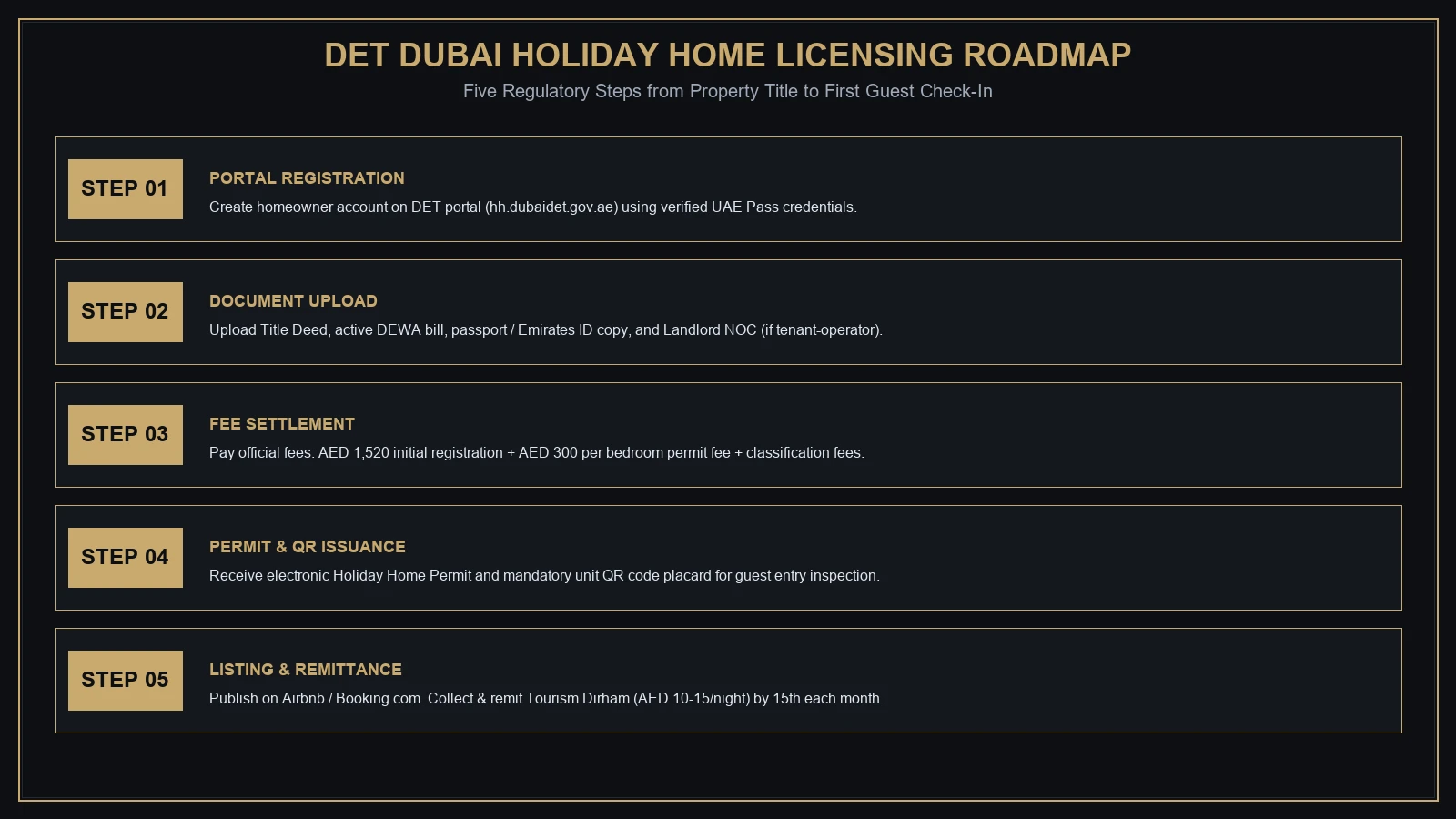
- Account Registration: Log on to the DET Holiday Homes Portal and sign in using your verified UAE Pass.
- Add Residential Unit: Enter the Makani Number (Dubai's 10-digit spatial coordinate code), building name, unit number, and upload the Title Deed and DEWA bill.
- Classification Selection: Select the property classification—Standard or Deluxe—based on interior specifications, building amenities, and furnishings.
- Fee Payment: Pay the online registration and permit fees via UAE credit card or e-Dirham gateway.
- Download Certificate & QR Code: Upon automated verification, download your official Holiday Home Unit Permit and print the required QR Code placard for display in the entrance foyer.
Permit Validity and Renewal
A Dubai Holiday Home Permit is valid for one calendar year (12 months) from the date of issuance. Renewal must be completed through the DET portal prior to expiry to prevent automatic listing deactivation. The annual renewal fee is AED 370 per bedroom plus standard administrative surcharges.
Costs Involved: Real Government & Operational Tariffs
Permit Fees by Unit Type and Classification
The upfront licensing fees payable directly to the Department of Economy and Tourism (DET) include:
| Fee Component | Standard Apartment | Deluxe Apartment / Villa | Frequency |
|---|---|---|---|
| Homeowner Portal Registration | AED 1,520 | AED 1,520 | One-time |
| Permit Fee (Per Bedroom) | AED 300 / bedroom | AED 300 / bedroom | Annual |
| Classification Certificate | AED 50 | AED 50 | Annual |
| Knowledge & Innovation Surcharges | AED 20 | AED 20 | Per Transaction |
| Total Year 1 Licensing (1-Bed Unit) | AED 1,890 | AED 1,890 | Year 1 Entry |
Tourism Dirham Fee Per Occupied Night
Hosts must collect the municipal Tourism Dirham from guests and remit it monthly to DET:
- Standard Classification: AED 10 per room, per occupied night.
- Deluxe Classification: AED 15 per room, per occupied night.
Critical Rules: If a 2-bedroom deluxe apartment is booked for 7 nights, the payable Tourism Dirham is 2 × 15 × 7 = AED 210. For long stays exceeding 30 consecutive nights by the same guest, the Tourism Dirham fee is capped and charged only on the first 30 nights. All remittances must be filed and settled online by the 15th day of every subsequent month to avoid municipal late fees.

Ongoing Operating Costs: The Hidden Expenses
First-time investors frequently make the mistake of multiplying peak-season nightly rates by 365 days and assuming the difference over long-term rent is pure profit. In reality, short-term rentals carry significant operational overhead:
- Furnishing & Styling: High-quality hotel-grade furniture, orthopaedic mattresses, smart TVs, kitchen appliances, and initial linen sets cost between AED 30,000 and AED 55,000 for a 1-bedroom apartment, amortized over a 3-year replacement cycle (~AED 12,000/yr).
- Utility Accounts (DEWA, Wi-Fi & Chiller): In short-term letting, the landlord pays all utilities. For a 1-bed, DEWA averages AED 800–1,100/month, high-speed Wi-Fi costs AED 350–400/month, and district cooling (chiller) adds AED 400–600/month during summer. Total utility cost: AED 18,000–24,000 annually.
- Platform Commissions: Airbnb and Booking.com retain 15% to 18% of the gross nightly rate in platform service charges.
- Cleaning & Laundry Turnover: Professional hotel turnover cleaning and commercial laundry cost AED 120 to AED 220 per guest checkout.
- Building Service Charges: The baseline master developer maintenance fee remains the landlord's obligation—see our detailed Dubai Service Charges Guide for per-sq-ft rates.
Short-Term vs Long-Term Returns — The Real Financial Math
Worked Example: 1-Bedroom Apartment in Dubai Marina
Let us compare a realistic financial model for a prime 1-bedroom apartment in Dubai Marina (Purchase price: AED 1,500,000; 800 sq ft):
| Financial Metric | Strategy A: Long-Term Ejari Lease | Strategy B: Short-Term Holiday Home (DET) |
|---|---|---|
| Gross Annual Revenue | AED 110,000 (1-2 cheques) | AED 155,000 (Avg AED 550/night @ 77% occupancy) |
| Platform / Agent Fees | AED 5,500 (5% leasing commission) | AED 24,800 (16% platform fee) |
| Utilities (DEWA, Wi-Fi, Chiller) | AED 0 (Paid by tenant) | AED 20,400 / year |
| Cleaning, Laundry & Consumables | AED 0 (Tenant responsibility) | AED 7,800 / year |
| DET Permit & Tourism Fees | AED 220 (Ejari registration) | AED 1,890 permit + collected from guest |
| Furnishing Wear & Tear (3-Yr Amort) | AED 0 (Unfurnished) | AED 12,000 / year |
| Building Service Charges | AED 14,400 (AED 18/sq ft) | AED 14,400 (AED 18/sq ft) |
| NET ANNUAL CASH RETURN | AED 90,100 (6.01% Net) | AED 73,710 (4.91% Net) — Self-Managed: AED 97,500 (6.50% Net)* |
*Note: If managed via a 20% full-service operator, net return drops to AED 73,710. If self-managed with zero agency cut, net return is approximately AED 97,500 (6.5% Net).
Occupancy Rate Reality & Dubai Seasonality
Unlike European capital cities where tourist volumes remain relatively flat year-round, Dubai experiences extreme seasonal variance:
- Peak Season (October to April): 85% to 95% occupancy. Nightly rates peak between AED 650 and AED 1,400+ during New Year's Eve, COP, and global trade fairs.
- Shoulder Season (May & September): 65% to 75% occupancy. Nightly rates normalize to AED 380–500.
- Summer Low Season (June to August): 45% to 60% occupancy. Rates drop to AED 220–350/night as temperatures rise and regional tourists look for budget staycations.
An investor who cannot tolerate months where cash flow barely covers DEWA and chiller bills should not pursue a short-term rental strategy.
Which Communities Actually Suit Short-Term Letting?
Not every Dubai neighborhood generates holiday home demand. Based on booking velocity across international platforms, only specific districts support the higher operational cost structure:
- Dubai Marina & JBR: Top tourist demand; walking access to beach, tram, and nightlife. Strong European and Gulf vacationer volumes.
- Downtown Dubai: Year-round business and leisure travelers; walking distance to Dubai Mall and Burj Khalifa. Highest average daily rates (ADR).
- Palm Jumeirah: High-end luxury segment; townhouses and waterfront apartments generate premium rates, particularly from luxury family groups.
- Business Bay: Corporate business travelers attending events in DIFC or DWTC; strong mid-week corporate occupancy.
Conversely, suburban family communities like JVC, Dubai South, or International City generally deliver superior net returns under long-term Ejari leases due to lower tourist footfall and higher price sensitivity.
Using a Licensed Operator vs Self-Managing
What Professional Operators Charge & Handle
Professional holiday home companies charge between 15% and 22% of gross monthly rental income. In exchange, they typically deliver:
- Professional dynamic pricing algorithms adjusting daily rates based on local hotel occupancy, events, and competitor velocity.
- 24/7 guest communications, check-in greeting, and key lockbox management.
- In-house linen laundering, toiletry replenishment, and scheduled turnover housekeeping.
- Mandatory DET guest reporting and monthly Tourism Dirham calculation and payment.
- Minor repair coordination and security deposit dispute handling with Airbnb.
When Self-Managing Makes Sense
Self-managing makes economic sense only if you meet three specific criteria:
- You are a UAE resident living within a 20-minute drive of the rental property.
- You have established relationships with reliable, on-call cleaning crews and maintenance handymen.
- You have the time and responsiveness to reply to guest inquiries within 15 minutes (a requirement to maintain Airbnb Superhost status).
If you are an overseas investor based in the UK, India, or Europe, attempting to self-manage across different time zones will quickly lead to negative reviews, lower search rankings, and administrative fines.
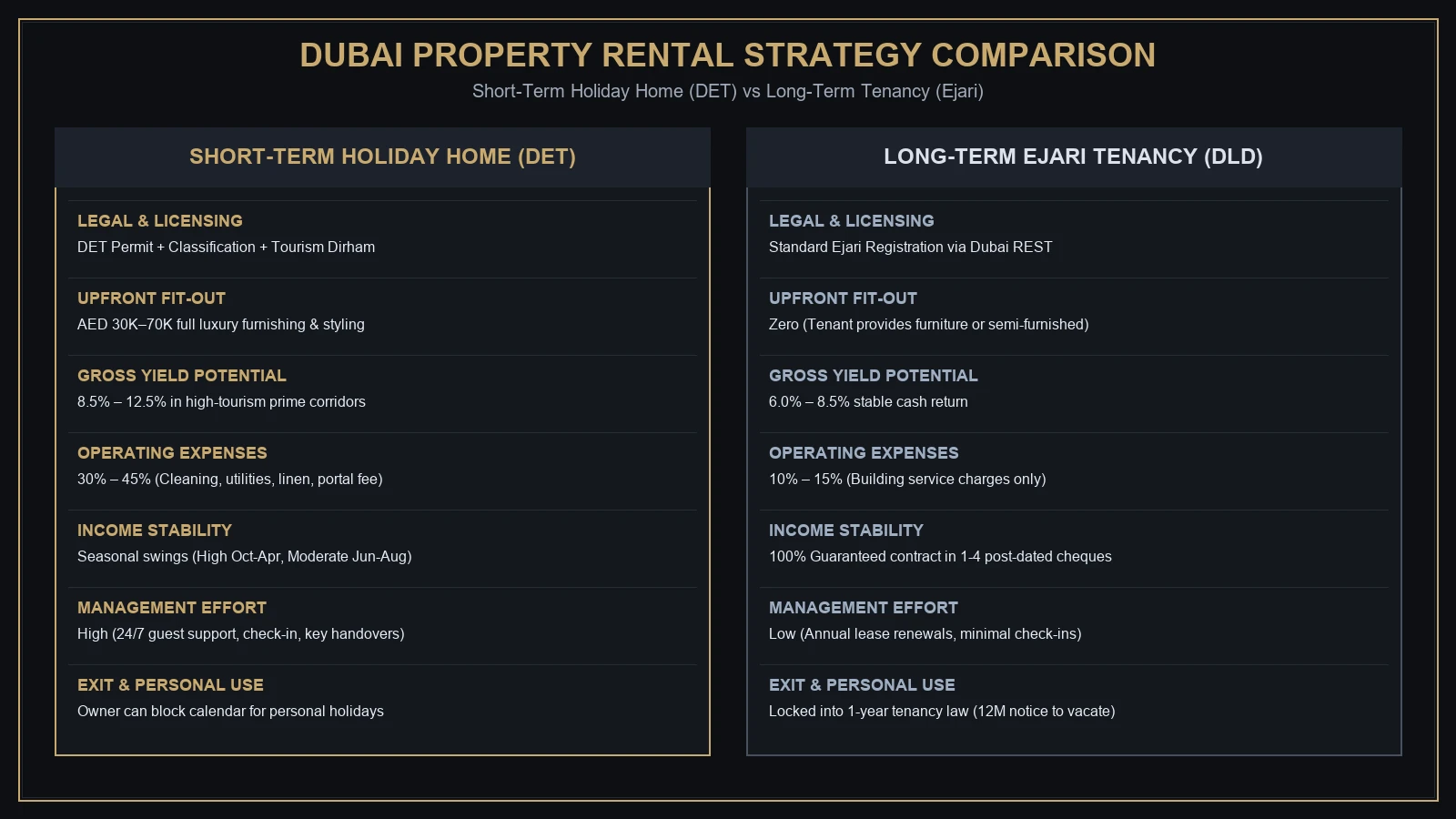
Comparing Rental Strategies: Long-Term vs Holiday Homes
When evaluating net returns and operational overhead between standard leasing and short-term rentals, two primary options emerge:
Standard Long-Term Ejari Lease
Best For: Overseas investors seeking passive, hands-off income.
Advantages: Zero furnishing capital, tenant pays all utilities, 100% predictable cash flow in 1 to 4 cheques, no licensing overhead or seasonal vacancy risk.
Holiday Home via Licensed Operator
Best For: Owners of prime Marina, Downtown, or Palm properties who also want personal holiday usage.
Advantages: Maximizes peak-winter rates, maintains apartment condition through regular cleaning, and allows the owner to block calendar dates for personal vacations.
Frequently Asked Questions: Holiday Home Permits
Yes. Dubai's Department of Economy and Tourism (DET) allows individual homeowners to register as individual operators directly on the Holiday Homes portal without needing a commercial trade license, provided they own the property and obtain the mandatory Holiday Home Unit Permit.
The initial registration fee on the DET portal is AED 1,520 (inclusive of knowledge and innovation fees). In addition, each unit requires an annual permit fee of AED 300 per bedroom plus AED 50 for the classification certificate and administrative fees. Annual renewal is AED 370 per bedroom per year.
The Tourism Dirham fee is AED 10 per bedroom per night for Standard holiday homes, and AED 15 per bedroom per night for Deluxe holiday homes. The host or operator collects this from guests and must remit it to DET through the online portal by the 15th of each calendar month. For stays exceeding 30 consecutive nights, the fee only applies to the first 30 nights.
Gross revenues for short-term rentals in prime tourist districts like Dubai Marina, Downtown, and Palm Jumeirah can exceed long-term rental income by 20% to 35%. However, after deducting 30% to 45% in operating expenses (utilities, furnishing amortization, cleaning turnover, booking commissions, and management fees), net returns are often comparable (6.5% to 8.5% net) unless the property is premium, highly rated, and aggressively managed.