

In our popular guide on What Happens If Your Off-Plan Property Is Delayed, we examined the legal recourse available when a developer falls behind schedule. But what happens when construction finishes and you receive that eagerly awaited email stating: "Your Unit is Ready for Handover"?
For many investors and homeowners, this is the most exciting milestone of their property journey. Yet, it is also the single moment where buyers are most legally and financially vulnerable. Rushing through the handover process to collect keys—without conducting a methodical, technical snagging inspection—can leave you saddled with tens of thousands of dirhams in rectifying defective air conditioning, leaking bathroom waterproofing, hollow floor tiles, and faulty wiring.
Under UAE real estate laws, you possess powerful statutory consumer protections, including a mandatory 1-year Defect Liability Period (DLP) and a 10-year structural warranty. This step-by-step advisory manual covers everything you must execute between receiving the completion notice and turning your unit into a cash-generating rental asset.
Developer handover obligations, defect liability durations, and jointly owned property rules are strictly enforced under Dubai Law No. (6) of 2019 and Law No. (13) of 2008. Any clause in a developer sales agreement attempting to waive the statutory defect liability period is legally void. Buyers should confirm live project completion status via the official Dubai Land Department (Dubai REST) application.
What Happens When Your Off-Plan Property Is Ready
The Handover Notice and What It Obligates You to Do
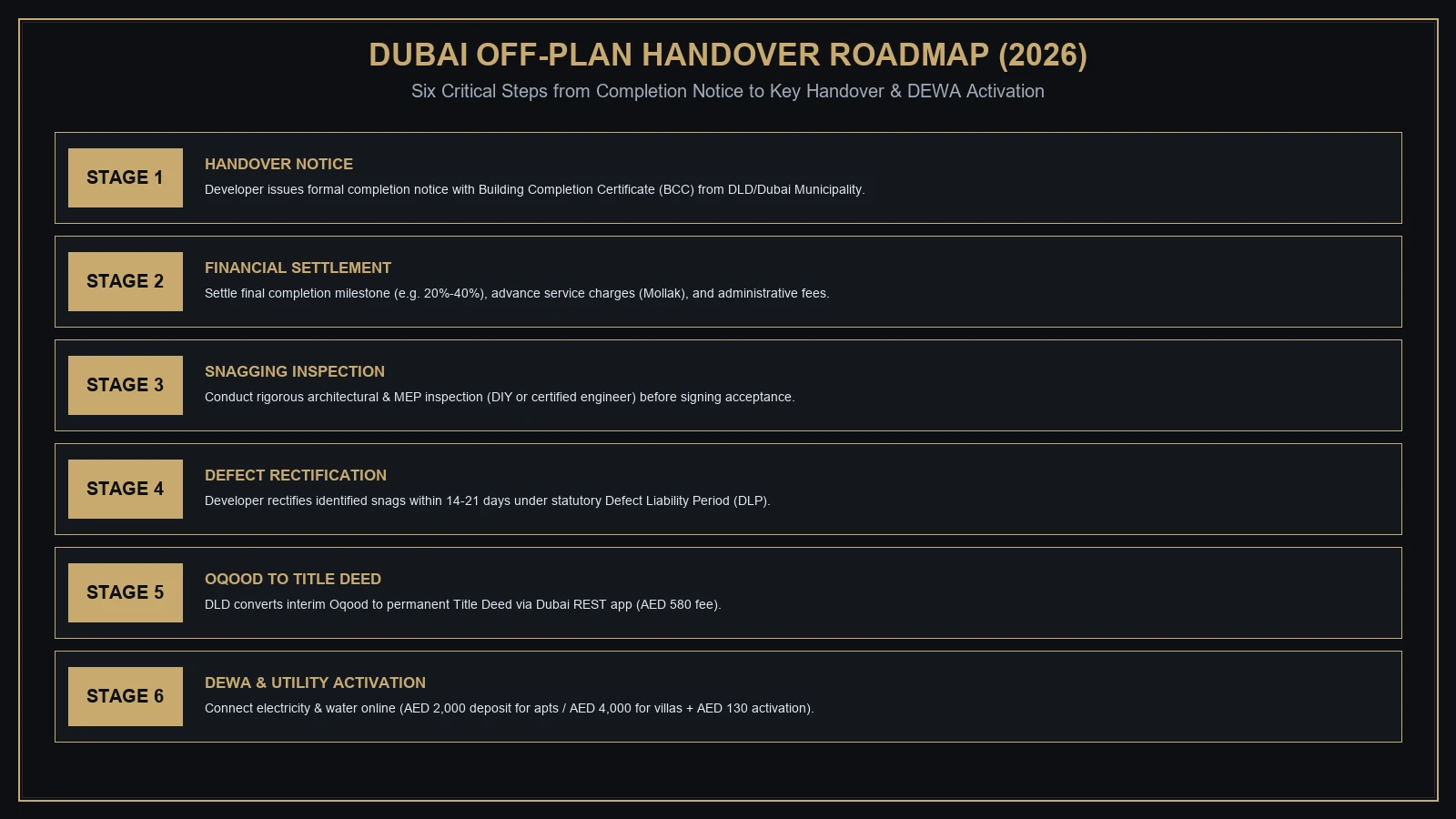
The handover process officially begins when the master developer issues a formal Notice of Completion and Handover. This notification is legally valid only after the developer has obtained the official Building Completion Certificate (BCC) from Dubai Municipality and civil defense authorities, certifying that the tower or community is safe for permanent human habitation.
The handover notice will typically specify:
- A deadline (usually 14 to 30 calendar days) to settle outstanding financial accounts.
- The contact details of the developer's handover operations department to book an inspection slot.
- The required advance payments, including master community service charges and utility meter installation fees.
Final Payment and Outstanding Balance Settlement
Before the developer permits you to inspect the unit or collect keys, you must complete full financial clearance:
- Completion Milestone: Payment of the final off-plan installment (commonly 20% to 40% of the purchase price, or the designated completion milestone specified in your Sales and Purchase Agreement).
- Advance Service Charges: Developers are legally permitted under RERA's Mollak system to invoice an advance service charge contribution (typically 3 to 6 months of building maintenance fees). See our detailed guide to Dubai Service Charges for calculation standards.
- Administration & Connection Charges: Chiller/cooling infrastructure connection fees (e.g. Empower, Emicool, or Tabreed) and DLD administrative clearance fees.

Typical Handover Timeline from Notice to Key Collection
For most Dubai projects, the transition from notification to move-in follows a 4-to-6 week timeline:
- Week 1: Receipt of BCC notification and financial statement; buyer transfers final installment funds.
- Week 2: Developer issues Statement of Account (Zero Balance Certificate); buyer schedules snagging appointment.
- Week 3: Technical snagging inspection conducted; detailed defect report submitted to developer site engineering team.
- Weeks 4–5: Developer contractors perform de-snagging (rectifying reported items); re-inspection visit conducted.
- Week 6: Signing of the Handover Acceptance Form, key handover package release, access card programming, and utility activation.
The Snagging Inspection: Why You Must Never Skip It
What Snagging Actually Means
In architectural and engineering terminology, snagging refers to a comprehensive visual, thermal, mechanical, and electronic inspection of a completed property to identify construction defects, substandard workmanship, non-functioning fixtures, and safety code violations.
Once you sign the unconditional Handover Acceptance Form without noting snags, the legal presumption shifts. While the Defect Liability Period still applies, proving that a cracked countertop or damaged door frame was caused by the builder—rather than by your furniture delivery team—becomes significantly more contentious.
Common Defects Found in Dubai Handovers
Even top-tier master developers rely on subcontracted labor forces working under intense handover deadlines. Based on data from thousands of residential handovers across Dubai, the most common snags include:
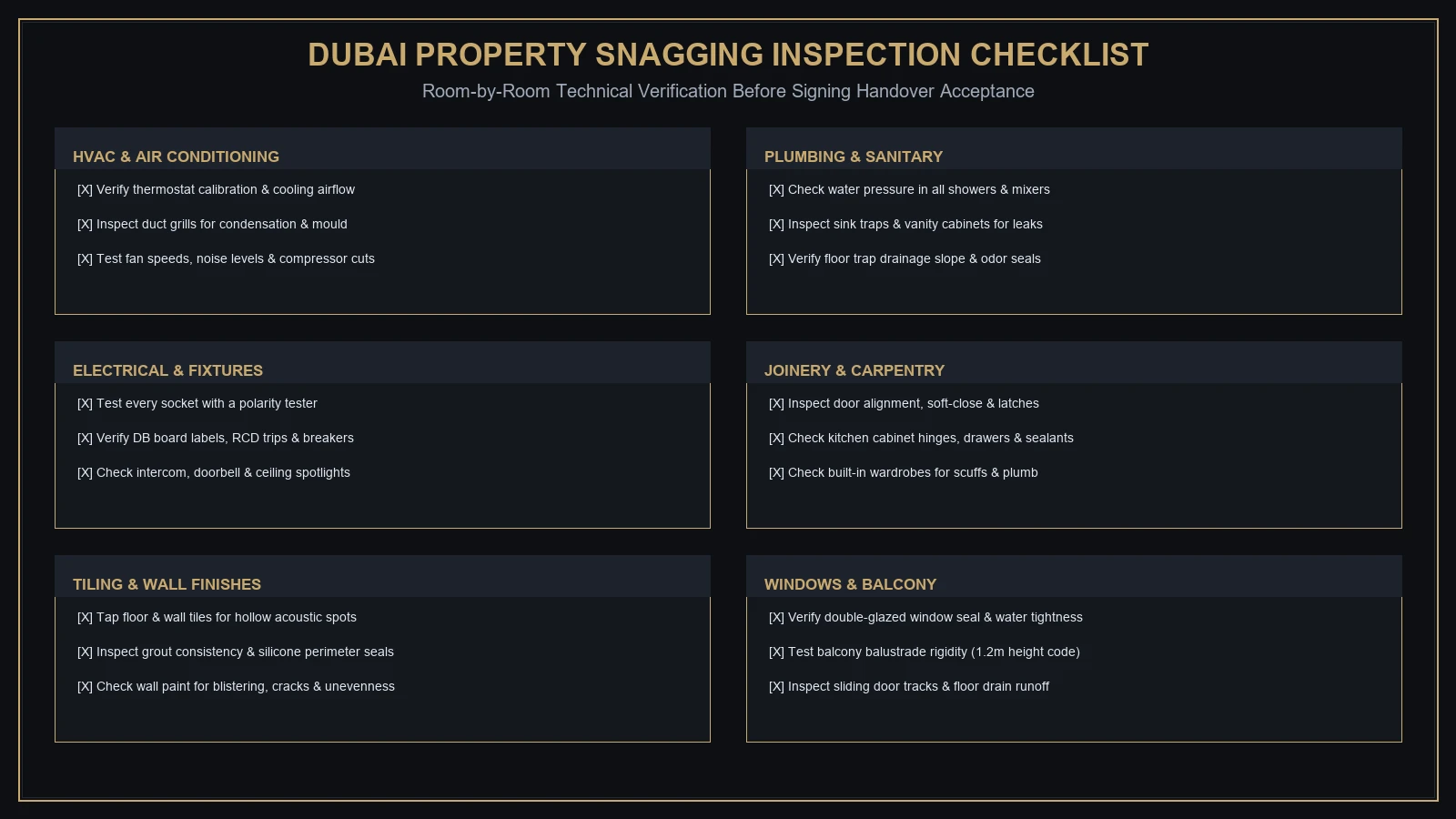
- HVAC & Chiller Faults: Reversed thermostat sensors, uninsulated ductwork causing ceiling condensation and toxic black mold growth, choked air filters, or improper airflow balancing.
- Plumbing & Waterproofing Failures: Inadequate gradient on shower floor tiles causing water pooling, leaking flexi-pipes underneath vanity basins, unsealed floor traps allowing sewer odors to back up into apartments.
- Electrical Non-Compliance: Ungrounded electrical outlets, faulty residual-current device (RCD) breakers on the distribution board, missing circuit breaker labels, and reversed polarity.
- Tiling & Flooring: Hollow tiles (where tile adhesive was poorly buttered, causing tiles to crack when heavy furniture is placed), chipped porcelain edges, and mismatched grout colors.
- Joinery & Glass: Misaligned kitchen cabinetry soft-close hinges, scratched double-glazed balcony sliding doors, and warped interior door leaves that rub against door frames.

DIY Inspection vs Hiring a Professional Snagging Company
Buyers frequently wonder whether they can inspect the unit themselves or should hire an external firm.
| Inspection Attribute | Self-Snagging (DIY Checklist) | Professional Snagging Firm |
|---|---|---|
| Cost | AED 0 | AED 1,200 – AED 2,500 (Apartments) |
| Equipment Used | Phone torch, measuring tape, golf ball (tile testing) | FLIR thermal cameras, laser levels, electrical socket analyzers, ultrasonic leak detectors |
| Hidden MEP Detection | Very limited (cannot test duct static pressure or hidden pipe leaks) | Complete diagnosis of HVAC airflow, thermal bridging, and electrical load balancing |
| Developer Pushback | Contractors often dismiss buyer notes as cosmetic complaints | Comprehensive stamped engineering reports citing Dubai Building Code standards that contractors cannot easily dispute |
The Defect Liability Period (DLP): Your Legal Rights
What the Developer Is Legally Obliged to Fix and For How Long
Under Article (26) of Dubai Law No. (6) of 2019, property developers are bound by two statutory warranty tiers:
- One-Year Fixtures & MEP Warranty (1 Year): Developers are legally liable to repair or replace defective mechanical, electrical, sanitary, plumbing, and interior fittings for exactly 365 days from the official handover date.
- Ten-Year Structural Warranty (Decennial Liability): Under Article 880 of the UAE Civil Transactions Law (Federal Law No. 5 of 1985) and Jointly Owned Property regulations, developers and main contractors remain jointly liable for 10 years for any total or partial collapse of structural foundations, columns, retaining walls, or reinforced concrete framing.
How to Formally Report Defects and Escalate If Ignored
If contractors stall or ignore your reported defect list:
- Always communicate via formal digital channels: Submit written defect tickets through the developer's official CRM portal and send a registered email to the Customer Care Director attaching the photographic snagging report.
- Never rely on verbal promises: On-site foremen frequently promise fixes that are never logged in the system.
- RERA Escalation: If a developer refuses to rectify legitimate MEP or structural defects within a reasonable window (typically 21 to 30 days), lodge a formal complaint via the Dubai REST application under the RERA Real Estate Grievance portal.
From Oqood to Title Deed: The Legal Transition
What Oqood Is and How It Differs from a Title Deed
During the construction phase, off-plan buyers hold an Oqood Certificate (Arabic for "Contracts")—an interim property registration document issued by the Dubai Land Department confirming your off-plan purchase in the interim register under Law No. (13) of 2008.
Upon building completion, the Oqood certificate must be formally converted into an unconditional Title Deed (Mulkiya). A Title Deed confirms you as the registered freehold owner in the DLD permanent registry, entitling you to execute long-term Ejari leases, mortgage financing, or apply for a UAE Golden Visa if the property value exceeds AED 2,000,000.
The DLD Conversion Process and Fees
Converting your Oqood into a Title Deed does not require repaying the 4% DLD transfer fee (which was already paid at initial off-plan purchase). The fees at handover are purely administrative:
- Title Deed Issuance Fee: AED 580 (including innovation and knowledge fees).
- DLD Trustee / Registration Office Fee: AED 4,000 + 5% VAT (if processing via an external DLD Trustee Center, often covered by developers in promotions).
- Site Survey Fee: Approximately AED 250 for final unit dimension validation.
The Title Deed is generated electronically within 24 to 48 hours and can be instantly viewed, verified, and shared directly inside your Dubai REST mobile application.
Post-Handover Setup: Utilities, Service Charges & Move-In
DEWA Connection and District Cooling Activation
To inhabit or rent the property, activate utility accounts immediately after collecting keys:
- DEWA Move-In Activation: Apply online at DEWA's Official Customer Portal. Provide your Title Deed, Emirates ID/Passport, and DEWA Premise Number (affixed to the apartment door frame).
- Refundable Security Deposit: AED 2,000 for apartments; AED 4,000 for villas.
- Activation Charges: AED 130 (connection and administrative surcharges).
- District Cooling (Chiller): If the building uses district cooling (Empower, Tabreed, Emicool), register directly with the utility provider. A separate refundable deposit of AED 1,500 to AED 2,000 is required.
Moving In vs Listing for Rent Immediately
If your property is an investment asset, do not delay marketing:
- Professional Photography: Schedule high-resolution interior photography the day after de-snagging is finished while the unit is pristine.
- Tenancy Strategy: Decide whether your community commands higher net returns under an Ejari Long-Term Tenancy or an authorized DET Short-Term Holiday Home.
So What? Our Advisory Recommendation
To safeguard your capital and protect your net rental yield at the handover milestone, we recommend two proven courses of action:
Systematic DIY Snagging Checklist
Cost: Zero additional expense.
Best For: Studio or 1-bedroom apartments with simple mechanical layouts.
Strategy: Allocate a minimum of 2.5 unhurried hours. Bring a socket tester, phone torch, and spirit level. Document every cosmetic scratch and water leak with clear photo evidence before signing the acceptance sheet.
Certified Third-Party Snagging Report
Cost: AED 1,200 to AED 2,500.
Best For: Overseas investors, luxury 2-3 bed apartments, townhouses, and villas.
Strategy: Hire an independent engineering company equipped with thermal imaging cameras. The resulting 40-page technical audit forces developers to rectify costly hidden MEP issues before your 1-year warranty expires.
Frequently Asked Questions: Off-Plan Handover
Under Dubai Law No. (6) of 2019, developers are legally obligated to repair or replace any defects in mechanical, electrical, plumbing (MEP), sanitary installations, and interior finishes for a period of one (1) year starting from the handover date. Additionally, developers carry a statutory 10-year decennial liability for structural defects starting from the issuance of the Building Completion Certificate.
Yes, if there are major material defects that render the property uninhabitable or non-functional (such as non-working air conditioning, major plumbing leaks, or electrical hazards). For minor cosmetic snags (paint touch-ups, scuffs), developers typically require you to complete financial settlement while formally appending the snagging inspection report for de-snagging rectification within 14 to 21 days.
A professional third-party snagging inspection conducted by certified civil and MEP engineers typically costs between AED 1,200 and AED 1,800 for a studio or 1-bedroom apartment, AED 1,800 to AED 2,500 for a 2-to-3-bedroom apartment, and AED 3,000 to AED 5,500 for luxury townhouses and standalone villas.
Oqood is the interim off-plan registration certificate issued by the DLD. Once the developer obtains the Building Completion Certificate (BCC) and settles final infrastructure milestones, the title is transferred into a permanent Title Deed via the Dubai REST app or a DLD Trustee Office upon paying standard administrative issuance fees (approximately AED 580).